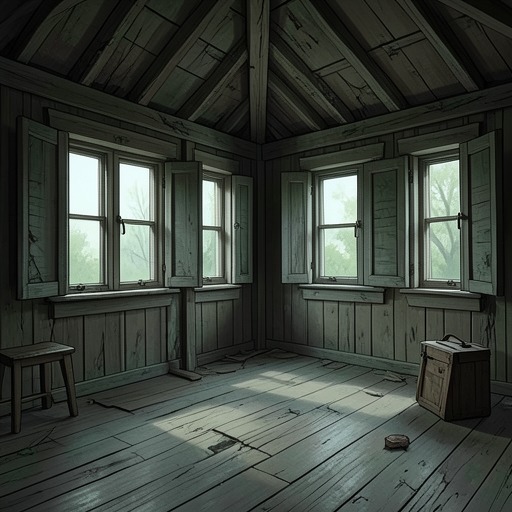
Restoration of the Ramsay Summer House
To the LighthouseThe restoration of the Ramsay Summer House is a hard-won interruption of the house’s drift toward ruin. After years of neglect, Mrs McNab and Mrs Bast scrub, clear, and repair its rooms, while George cuts the grass and builders are brought in; their labor retrieves household belongings from dust and decay and prepares the house for the family’s possible return. Its reopening makes the domestic past inhabitable again, but cannot reverse bereavement, time, or the losses carried by the rooms.
The House at the Edge of Ruin
The work begins at a point of near-abandonment. The house has stood without consistent care, its cupboards and rooms deteriorating while the grounds become overgrown. Mrs Bast recalls uncertainty about who had been responsible for the property: Kennedy’s injured leg had interrupted his work, and later care may have been irregular. Even the garden’s future is uncertain; seeds might have been sent, but no one could be sure they had been planted. The house’s condition is therefore not a single catastrophe so much as the accumulated result of absence and neglected maintenance.
The narrative imagines how little might have separated the house from total disappearance. Had it tipped further into decay, its roof might have fallen, briars and hemlocks swallowed the paths and windows, and only scattered remnants such as a poker or a piece of china marked the place where people had lived. Against this imagined erasure, the restoration is modest but decisive: a few workers’ sustained effort keeps the house from being lost altogether.
Labor Against Decay
Mrs McNab and Mrs Bast arrive with brooms and pails and begin the slow work of mopping and scouring. They are old and stiff, and the work makes them groan as they move through the house, upstairs and down to the cellars. Their labor is neither ceremonious nor effortless: it is a practical, bodily struggle against rot and accumulated dirt, carried out with the tools and strength available to them. When one of the young women writes to ask that the house be made ready, the request gives urgency to work that has been proceeding against a much longer decline.
The restoration recovers particular objects rather than making the past abstract. Mrs McNab and Mrs Bast bring the Waverley novels and a tea-set back into view, then restore a brass fender and a set of steel fire-irons to the air and light. They also confront the unevenness of the task: the taps and bath represent a conspicuous achievement, while the long rows of books remain a more arduous and only partial victory. Once dark with age, the books are now white-stained, and spiders and pale growth have taken hold among them. The house can be cleaned and some of its contents rescued, but its condition records the extent of its neglect.
Mrs McNab’s memories give the work a domestic history. She remembers the house as a place that once held many people, sometimes twenty guests, with washing-up continuing until late at night. She also recalls the cook, Mildred, who saved food for Maggie. These recollections contrast the former abundance and activity with the present labor of bringing rooms back into use. Domestic life is not restored by the house itself: cleaning, cooking, maintenance, and the preparation of rooms depend on workers whose efforts sustain the comfort others remember.
A Household Made Ready Again
The restoration extends beyond the rooms. Mrs Bast watches her son George scythe the grass, while he also catches the rats; builders contribute to the repairs inside. The work joins cutting and digging outdoors to scrubbing and clearing within, so that recovery depends on several kinds of maintenance rather than on one dramatic repair. The sounds of swollen woodwork, hinges, and bolts accompany the workers as they move through the house, making its physical resistance part of the process.
After days of labor indoors and work in the grounds, the windows are dusted and shut, the keys turned, and the front door closed. That final sequence marks a change in the house’s state: it has been made ready, though not returned to an untouched former condition. The restoration is practical and provisional. It prepares the property for renewed occupation, while the visible signs of neglect and the partial nature of the repairs remain part of its history.
Return and Narrative Significance
Lily Briscoe arrives at the house late one evening in September, and Augustus Carmichael comes by the same train. Their return follows the workers’ completion of the preparations and restores human presence to a place that has been empty for a long interval. The house is full again, with Mrs Beckwith also staying there. Its return to use is thus registered not only in cleaned rooms but in people arriving, settling, and sleeping within them.
The restoration stands between two kinds of time. The house’s deterioration has gathered through absence, weather, and repeated neglect; its recovery proceeds through repetitive tasks that retrieve particular objects and make rooms usable. The workers do not undo what has happened to the family, nor does a clean room restore what death has taken. Rather, their effort preserves a setting in which life can continue and memory can recur. The house’s renewed readiness is a material achievement, but its meaning remains bounded by the irreversible losses that have passed through it.